Zara Is Not a Fashion Brand. It Is a Data System Wearing a Jacket.

How one shirtmaker from Spain engineered speed into an entire global industry — and what the cost of that speed actually looks like.
You have felt it before even if you could not name it. You walk into Zara, pick up a jacket, put it back, and think you will return for it next week. By next week it is gone. A completely different rack has taken its place. That feeling of urgency is not an accident. It is the product. Zara did not stumble into creating it. They engineered it, deliberately, over decades, by rebuilding how the entire fashion supply chain moves.
This is not a story about clothes. It is a story about what happens when you optimize a global system for one thing above all else, and who ends up carrying the weight of that choice.
It started with a shirtmaker, not a designer
Amancio Ortega did not found Zara because he had a vision for fashion. He founded it because he saw a structural flaw in how fashion worked. In the 1970s in Galicia, Spain, one of the poorest regions in Western Europe at the time, Ortega was making shirts. He watched the industry around him place enormous orders months in advance, gamble on what consumers would want by the time those orders arrived, and quietly absorb enormous losses when those guesses were wrong.
His insight was not glamorous. It was operational.
Fashion does not fail because people do not want clothes. It fails because companies wait too long to respond.
Instead of predicting demand, Zara would wait for it to appear and then move faster than anyone else. That idea sounds obvious now. In the 1970s, it was a complete reinvention of how the industry was structured.

The problem Zara was solving was enormous
By the late 1990s, most fashion brands were still working on four to six month timelines. Designers locked collections in advance. Orders were placed half a year before anything reached a store. Factories ran massive batches, and by the time the clothes arrived, the trend had either landed or already passed.
When brands got it wrong, racks filled with leftovers. Clearance sales followed. By the 2010s, the industry was sitting on between seventy and one hundred and forty billion dollars in unsold stock globally. Warehousing, markdowns, and write-offs regularly consumed twenty to thirty percent of a garment's value before it ever left the shelf.
That was the cost of guessing. Zara decided not to guess.
How Zara rebuilt the fashion clock
Everyone else: Design locked months ahead. Orders placed six months before delivery. Large batches. High risk of unsold inventory.
Zara: Wait for real demand signals. Design after the trend appears. Sketch to shelf in fifteen to twenty-one days. Small batches that scale when something works.
The system that made it possible
Zara did not achieve this by being smarter about fashion. It achieved it by redesigning the information loop. Store managers stopped being just salespeople. Every day, they fed data back to headquarters in Arteixo, Spain: what customers reached for, what sold out by Tuesday, what sat untouched by Friday. That stream of feedback never stopped.
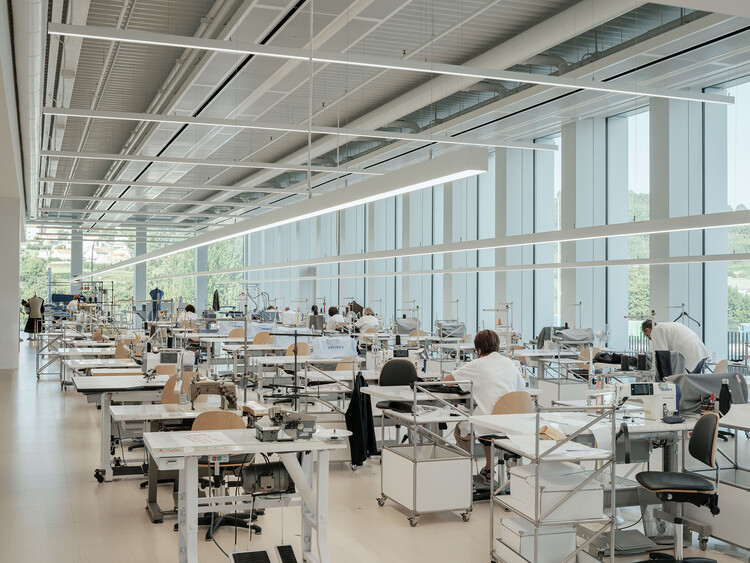
Zara Arteixo Office
Design, cutting, dyeing, and distribution were all kept close to headquarters in Spain and Portugal, not to save money on labor (it was more expensive there than in Asia) but to eliminate waiting. Proximity meant responsiveness. Responsiveness meant speed.
Today, Zara operates over 5,800 stores in around 95 countries. Every one of them receives fresh inventory twice a week, every Tuesday and Friday, without exception. Items spend less than 24 hours in a distribution center before they are on the move again. Factories receive orders two to four weeks before delivery, sometimes less. When demand spikes, turnaround windows can shrink to ten days.
How speed becomes pressure without anyone saying so
Here is where the story gets more complicated.
Zara works with roughly 1,600 to 1,800 direct suppliers. But those suppliers rely on a much wider network. Inditex's own disclosures list over 7,000 factories and workshops worldwide. Sewing, the most labor-intensive stage, is frequently subcontracted further when deadlines get tight. At each step down the chain, margins thin. Industry estimates suggest that by the time sewing reaches smaller subcontracted workshops, profit per garment can fall to just a few cents per piece.
There are no formal written penalties for missing a shipment. The consequence is quieter. The phone stops ringing. Factories that can absorb volatility by extending shifts, adding weekend hours, or pushing work further down the chain stay in the system. Those that cannot are replaced. Over time, the network filters itself toward flexibility.
No one has to threaten anyone. The calendar enforces everything.
Brazil, 2011: when the system had a name put to it
In 2011, Brazilian labor inspectors traced Zara garments beyond official supplier lists and into small sewing workshops on the outskirts of Sao Paulo. What they found were workers, many of them migrants from Bolivia and Peru, sewing fourteen to sixteen hours a day. Several lived inside the factories, sleeping near their machines. Wages, when calculated against hours worked, fell below the legal minimum. The Brazilian government classified the situation as forced labor.
The factories were not owned by Zara. They did not need to be. They were subcontractors hired by suppliers producing for Zara. That legal distance mattered, but it did not break the production link.
Inditex responded seriously. The company paid penalties, terminated the supplier relationships involved, and signed a legally binding agreement with Brazilian authorities accepting responsibility for monitoring not just direct suppliers but their subcontractors too. By 2014, regulators publicly confirmed that Zara had met the required corrective measures and removed it from their monitoring list.
But the delivery schedule stayed the same. Stores still received new stock twice a week. Lead times stayed compressed. The same structural incentives that had pushed pressure down the chain before the raids were still in place afterward. Audits became more thorough. Transparency improved. The clock did not change.
The environmental scale
10%
of global carbon emissions from fashion
92M
tons of textile waste generated annually
>50%
of fast-fashion garments discarded within one year
What Zara did about its environmental footprint
Zara's response to growing environmental criticism was not to slow down. It was to change the inputs. The company rolled out its Join Life label across most of its collections, signaling garments made with recycled polyester, lower-impact cotton, and dyeing processes designed to use less water and energy. At the corporate level, Inditex has committed to net-zero emissions by 2040, one hundred percent preferred or recycled fibers by 2030, and reduced water and energy use across its supply chain.
Those commitments required real investment. New materials, new suppliers, new reporting infrastructure.
The release cycle stayed the same. Stores still turned over inventory twice a week. Designs still came and went at the same pace. The footprint per individual item shrank. The number of items did not. That tension, sustainability layered onto a machine built for speed, is the part Zara has not fully resolved.
Why this is a STEM case study, not just a business one
This is the part I want every aspiring entrepreneur and systems thinker to sit with.
Zara did not set out to create labor violations or environmental damage. It set out to eliminate hesitation. It replaced forecasting with feedback loops, seasons with weeks, and uncertainty with precision. It engineered speed so deeply into its logistics, data flows, and supplier incentives that everything else around it had no choice but to reorganize in response.
That is genuinely impressive from a systems design perspective. It is also exactly where the most important questions live.
Systems do not announce their values. They reveal them, quietly, through what they optimize for. Zara optimized for time. And everything else reorganized around that choice.
For anyone learning to build systems, whether in technology, supply chains, products, or organizations, Zara is one of the most important case studies available. Not because it is a model to copy, but because it shows with unusual clarity what powerful design choices look like when they are embedded deep inside logistics and incentives rather than stated in a mission statement.
The question it leaves you with is the one worth carrying into whatever you build next. Not just: can this be done faster? But: who carries the cost when it is?


Comments